Wärtsilä Scales Up: 30 Per cent Increase in Engine Production to Meet Green Transition Demand
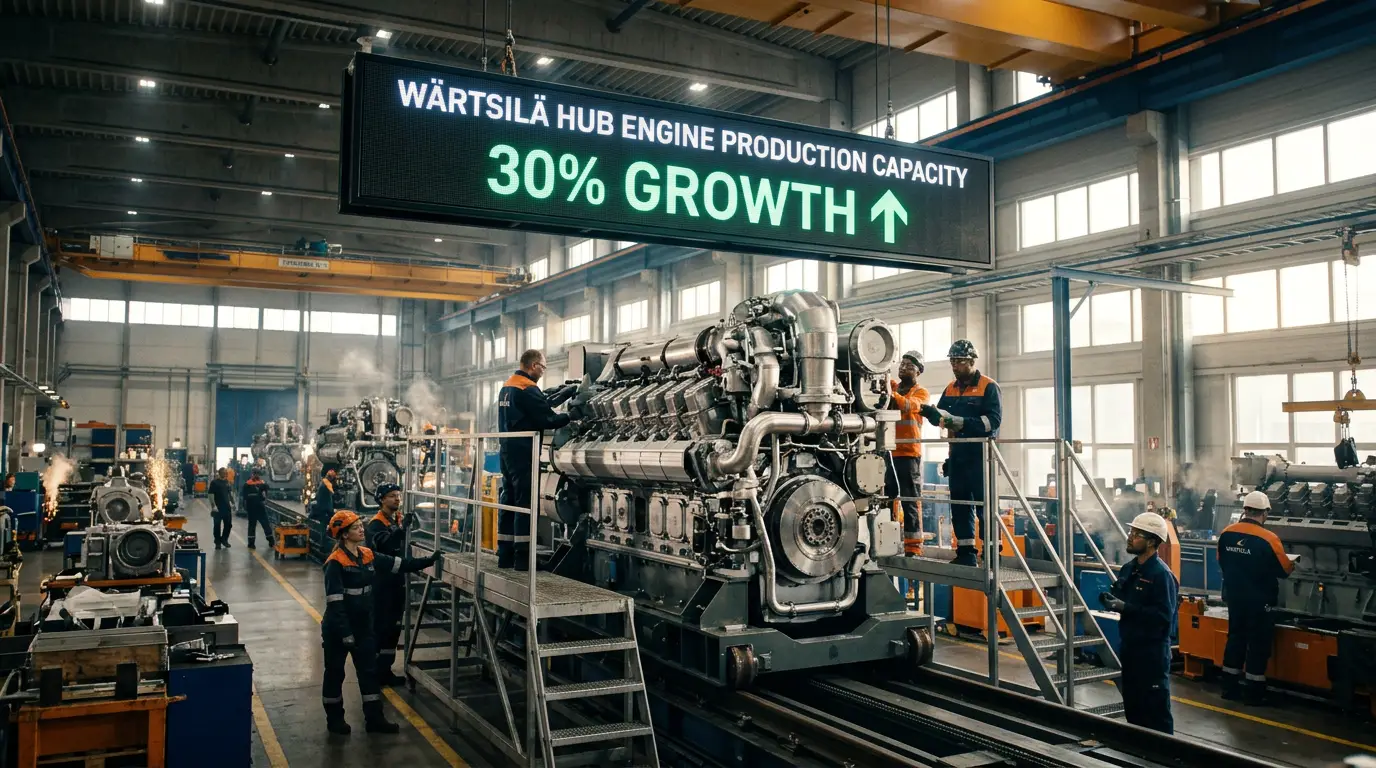
Wärtsilä is significantly increasing its industrial footprint to meet a rise in global orders as the new construction order book picks up. The technology group recently announced a plan to expand Wärtsilä Engine Production Capacity by another 30 per cent, primarily focusing on its state-of-the-art Sustainable Technology Hub Vaasa in Finland.
This capital investment is a direct response to the mounting demand for energy-market engines as utility providers and shipowners scramble to secure equipment capable of operating on a variety of low-carbon fuels. By scaling its assembly and testing capabilities, Wärtsilä aims to shorten lead times and reinforce its position at the centre of the global energy transition.
Market Forces and the Regulatory Push for Decarbonization
The primary driver behind this expansion is the tightening web of environmental regulations issued by the International Maritime Organisation (IMO) and regional bodies like the European Union. With the implementation of the Carbon Intensity Indicator (CII) and the FuelEU Maritime initiative, the cost of operating traditional, heavy-fuel-oil vessels is rising.
Consequently, the industry is witnessing a massive pivot toward dual-fuel and methanol-ready tonnage. Wärtsilä’s decision to boost capacity ensures it can deliver engines and hardware necessary for compliance, preventing a technical bottleneck that could stall the maritime decarbonization movement.
Commercial mechanics are also at play. Håkan Agnevall, President and CEO of Wärtsilä, has highlighted that the company is not just expanding in volume but in versatility. The energy sector is increasingly reliant on balancing power—engines that can ramp up quickly to support intermittent renewable sources like wind and solar. In the marine sector, the demand is for fuel-flexible marine engines that provide a hedge against future fuel price volatility and availability. By increasing production, Wärtsilä is betting on a future where the ability to switch between LNG, diesel, and future green fuels is the standard for operational survival.
Strategic Operations: The Sustainable Technology Hub Vaasa
At the heart of this expansion is the Sustainable Technology Hub Vaasa, a facility designed to integrate research, development, and production under one roof. Unlike traditional manufacturing plants, the Hub serves as a collaborative ecosystem where engineers can test new combustion cycles and fuel delivery systems in real-time. This integration is vital for the rapid deployment of next-generation propulsion systems. The 30 per cent capacity increase will involve significant upgrades to the facility’s logistics flow and testing halls, allowing more units to undergo factory acceptance tests simultaneously.
The expansion also ripples through the associated global supply chain. Wärtsilä’s move signals to tier-one and tier-two suppliers that they must also scale up production of specialised components like turbochargers, fuel injectors, and high-pressure pumps.
The strategic benefits of this growth include:
– Reduced delivery lag for newbuild projects, ensuring shipyards can meet their delivery schedules.
– Enhanced capability to produce 4-stroke engines that meet Tier III NOx emission standards.
– Faster iteration of retrofitting kits for existing vessels looking to switch to cleaner fuels.
– Strengthening of the European manufacturing base for high-tech maritime equipment.Operational Impact on Shipowners and Global Logistics
The increase in Wärtsilä Engine Production Capacity provides shipowners with much-needed relief from the growing waitlists for high-efficiency machinery. During the post-pandemic recovery, many owners found themselves locked into long lead times, sometimes delaying fleet renewal programs by years. Increased throughput means that owners can plan their transitions to green corridors with greater certainty. This is particularly relevant to the cruise and container segments, where adhering to a strict delivery window is essential to maintaining seasonal route commitments.
Technically, the availability of more fuel-flexible marine engines allows for more sophisticated risk management. Charterers are increasingly favouring vessels with superior “green” credentials to satisfy their own Scope 3 emission targets.
A shipowner who secures a Wärtsilä dual-fuel engine today is effectively future-proofing their asset against the risk of becoming stranded. Furthermore, operational data from a larger fleet of modern engines enables Wärtsilä to refine its predictive maintenance services, potentially lowering the long-term cost of ownership for operators by reducing downtime and improving fuel economy.
Future Outlook: Bottlenecks and Emerging Risks
While the capacity boost is a positive signal, the industry still faces significant hurdles. The most immediate concern is the global shortage of skilled maritime engineers and shipyard technicians. Scaling physical factory space by 30 per cent is a capital-intensive task, but staffing that expansion with specialised talent is an operational challenge that takes years to resolve. Wärtsilä and its peers must invest heavily in training and automation to ensure production quality remains consistent during this rapid growth phase.
Additionally, the industry must monitor the “chicken-and-egg” dilemma. While Wärtsilä can produce the engines, the commercial success of maritime decarbonization depends on the global availability of green methanol, ammonia, and hydrogen. If fuel infrastructure lags behind engine production, owners may find themselves with expensive dual-fuel hardware but no green fuel to burn, forcing them to rely on carbon-intensive alternatives and negating the environmental benefits. The next 24 months will be a critical period for aligning engine manufacturing output with global fuel bunkering infrastructure.
Global Energy transition impart
Wärtsilä’s 30 per cent capacity increase is more than a simple corporate expansion; it is a barometer for the pace of the global energy transition. By centring this growth at the Sustainable Technology Hub Vaasa, the company is ensuring that it can meet the complex energy market demand of the next decade. As shipowners navigate a landscape of shifting regulations and fuel uncertainty, the availability of advanced, fuel-flexible hardware will be the primary factor determining who leads the next generation of global trade.
Data & Sources
– I (IMO) – Marine Environment Protection Committee (MEPC) Reports
– DNV – Maritime Forecast to 2050 and Fleet Analytics
– Wärtsilä Corporation – Annual Investor Relations and Sustainability Reports