

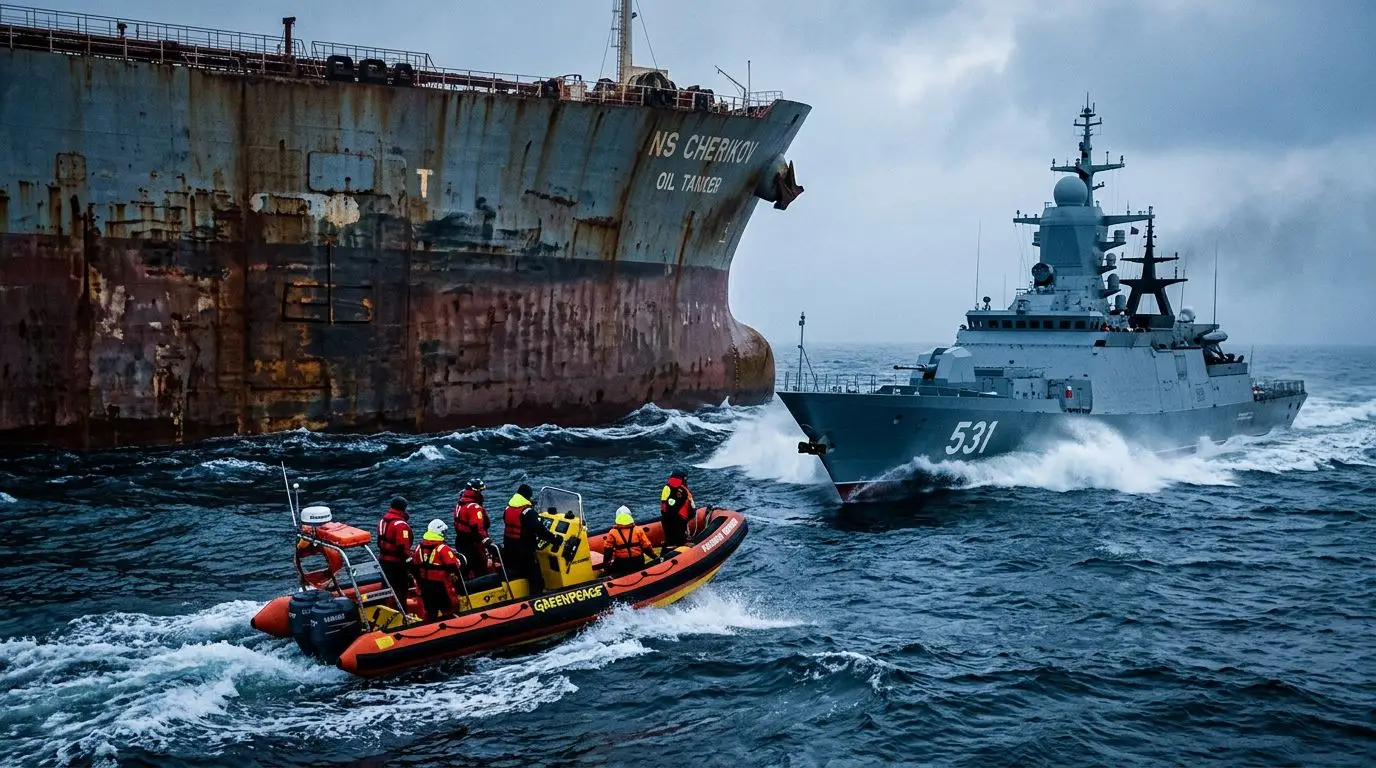
A Russian Navy corvette recently intercepted environmental activists during a routine monitoring operation, marking a significant escalation in maritime friction.
On the morning of June 30, a Russian Warship confronted Greenpeace in the Baltic Sea, ordering the group’s Nordic team to maintain a wide berth from a sanctioned crude oil tanker.
The activists were documenting the Kira K tanker, a vessel identified as part of a clandestine network moving Russian energy exports despite Western restrictions. This high-stakes encounter highlights the increasing militarisation of commercial shipping lanes as state actors move to shield their economic interests from public and regulatory scrutiny.
The vessel leading the interception was identified as a Steregushchiy-class corvette, a modern multi-role ship equipped with advanced radar and weapon systems. Its presence as an escort for a commercial tanker signals a shift in how the Russian shadow fleet operates within European waters. By providing a military shield for vessels engaged in maritime sanctions evasion, Russia is effectively challenging the authority of coastal states and the oversight roles of non-governmental organizations.
The Mechanics of Maritime Sanctions Evasion and the Shadow Fleet
Following the invasion of Ukraine, the G7 and European Union implemented a series of oil price caps and shipping bans designed to cripple the Russian economy. In response, a massive parallel infrastructure emerged, often referred to as the Russian shadow fleet. This fleet consists of hundreds of aging tankers, often with opaque ownership structures and registered under flags of convenience that provide minimal oversight.
These vessels, including the Kira K tanker, frequently operate without standard Western P&I insurance, which is required by most reputable ports and waterways. Instead, they rely on sovereign guarantees or obscure insurance providers that may not have the capital to cover a major spill. The International Maritime Organization (IMO) has expressed growing concern over these practices, as the lack of transparency makes it nearly impossible to ensure compliance with the MARPOL convention or the International Convention on Civil Liability for Oil Pollution Damage.
The commercial drivers are straightforward: profit and survival.
Russia must move approximately 3.5 million barrels of crude oil per day to global markets. To bypass the ban on using Western services, they have acquired a fleet of mid-to-late-life vessels, often at a significant premium. This strategy allows for the continued flow of oil to markets in Asia, but it places a massive burden on the safety and environmental integrity of the maritime commons.
Operational Challenges and Baltic Sea Environmental Risk
The use of a Russian Warship against Greenpeace in the Baltic Sea underscores a growing operational reality for legitimate shipowners and charterers. The Baltic is a semi-enclosed, shallow, and brackish sea with slow water exchange, making it one of the most ecologically sensitive marine environments in the world. Any major accident involving a shadow fleet vessel would result in an irreversible Baltic Sea environmental risk, potentially devastating the coastlines of several NATO and EU member states.
The operational impact on the shipping industry is multi-faceted: – Increased Insurance Scrutiny: Legitimate operators are facing higher premiums and more rigorous due diligence requirements to prove they are not inadvertently interacting with sanctioned entities.
– Routing and Congestion: As shadow vessels perform ship-to-ship (STS) transfers in international waters to hide the origin of their cargo, they create localized congestion and navigation hazards for commercial traffic.
– Regulatory Compliance Costs: Tech-driven compliance platforms are now essential for charterers to track vessel histories, dark-activity periods (where AIS is turned off), and complex ownership changes.
– Port State Control Pressure: Maritime authorities in the Baltic are being forced to increase inspections, diverting resources from general safety oversight to focus on sanctions enforcement and environmental monitoring.
For the seafarers working on these vessels, the risks are even more personal. Many are operating on ships with questionable maintenance records and limited access to legal or medical support.
Future Outlook: Escalation and Commercial Bottlenecks
The encounter between the Steregushchiy-class corvette and environmental monitors suggests that the “cat and mouse” game in the Baltic is entering a more dangerous phase. As the West tightens enforcement, the reliance on military escorts for sanctioned tankers is likely to increase. This could lead to more frequent close-quarters interactions between Russian naval assets and the coast guards of Baltic nations, raising the risk of miscalculation or accidental conflict in a heavily used waterway.
Industry analysts expect several key bottlenecks to emerge in the coming months.
The SHADOW Fleet Sanctions Act of 2026 and similar legislative frameworks in Europe are poised to target not just the vessels, but the entire support ecosystem, including bunker suppliers and port agencies. This will further drive the shadow fleet toward more remote and hazardous operational methods.
Furthermore, the aging nature of these tankers means that the probability of a technical failure increases with every voyage. The maritime community must monitor the development of a “dual-tier” safety system where one portion of the global fleet adheres to the highest IMO standards, while another operates in a regulatory vacuum. The long-term commercial risk is that a single catastrophic event involving a shadow tanker could lead to sweeping, reactive regulations that disrupt the entire global energy supply chain.
The intervention by a Russian naval vessel to protect a sanctioned tanker from observation marks a turning point in Baltic maritime dynamics. It proves that the shadow fleet is no longer just a commercial workaround; it is a state-supported strategic asset. For the shipping industry, this means navigating a landscape where geopolitical tension is as much a factor as freight rates or bunker costs. The environmental stakes in the Baltic Sea remain perilously high, and as long as the shadow fleet continues to operate behind a screen of military force, the risk of a combined ecological and diplomatic crisis grows.
Data & Sources – International Maritime Organization (IMO)
– Lloyd’s List Intelligence
– Center for Research on Energy and Clean Air (CREA)
