
Panama Canal Braces for El Nino: New Draft Restrictions to Impact Neo-Panamax Fleet
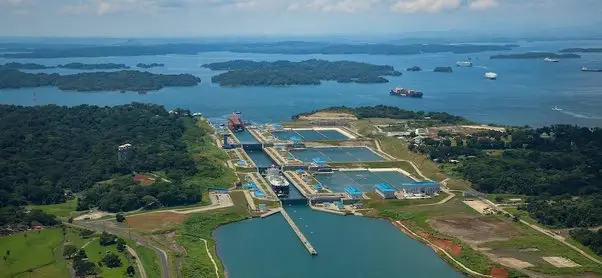
The Panama Canal Authority (ACP) has announced that it will reduce the maximum authorised draft for vessels transiting the Neopanamax locks to 49.5 feet, effective July 1, 2026.
Download the ACP notice here
This proactive measure comes in response to updated El Nino forecasts that predict significantly lower rainfall across the Panama Canal Watershed. These new Panama Canal Draft Restrictions are designed to preserve water levels in Gatun Lake, the primary reservoir for the canal’s lock systems. As the maritime industry prepares for another period of climatic volatility, the decision highlights the growing vulnerability of one of the world’s most critical trade arteries to shifting weather patterns.
The Drivers: El Nino Maritime Impact and Gatun Lake Water Levels
The necessity for these restrictions is rooted in the hydrological cycle of the Gatun Lake system. Unlike many other major waterways, the Panama Canal relies entirely on freshwater gathered from seasonal tropical rains. The El Nino phenomenon disrupts these predictable patterns, often leading to extended dry seasons and high evaporation rates that deplete Gatun Lake water levels faster than they can be replenished. When these levels drop below critical thresholds, the ACP must act to ensure the safety of navigation and the continued operation of the locks.
The ACP uses a sophisticated set of meteorological models, often in coordination with the World Meteorological Organization (WMO), to project these water shortages. While recent months saw a temporary improvement in conditions, the re-emergence of El Nino indicators has forced a return to conservative water management. For the Neopanamax vessel draft, even a half-foot reduction is significant, as it forces carriers to reconsider their stowage plans months in advance to avoid being turned away or forced to offload cargo.
Operational Impact: Managing Global Supply Chain Disruption
The Panama Canal’s water-scarcity challenges have fundamentally altered maritime transit economics. Relying on Lake Gatun’s freshwater, the canal’s operational capacity is intrinsically tied to regional precipitation. Intense droughts, notably in 2023, forced the Panama Canal Authority to reduce daily transits and impose strict draft limitations, lowering the standard from 50 feet to approximately 44 feet.
For shipowners and charterers, these restrictions translate into severe operational complexity and lost revenue. A Neo-Panamax vessel constrained by a lower draft cannot achieve its maximum deadweight capacity, forcing carriers to reduce cargo loads.
The industry is navigating these constraints through several critical adaptations:
-
Cargo Short-Loading: To comply with water management limits, carriers must often leave containers behind at departure ports.
-
Intense Slot Competition: As per-ship capacity drops, demand for available transit slots escalates, with lost time and fuel during delays significantly impacting daily profitability.
-
Strategic Rerouting: When transit fees or waiting times—which have exceeded 10 days during previous droughts—make Panama transit economically unviable, operators may divert to longer routes like the Cape of Good Hope or Cape Horn.
-
Divergent Sector Impacts: While containerships face a rigid “payload-to-draft” crisis—often suffering a 40% loss of TEU capacity per transit—bulk carriers act as flexible “swing capacity,” using route optimization to manage the canal as a variable cost.
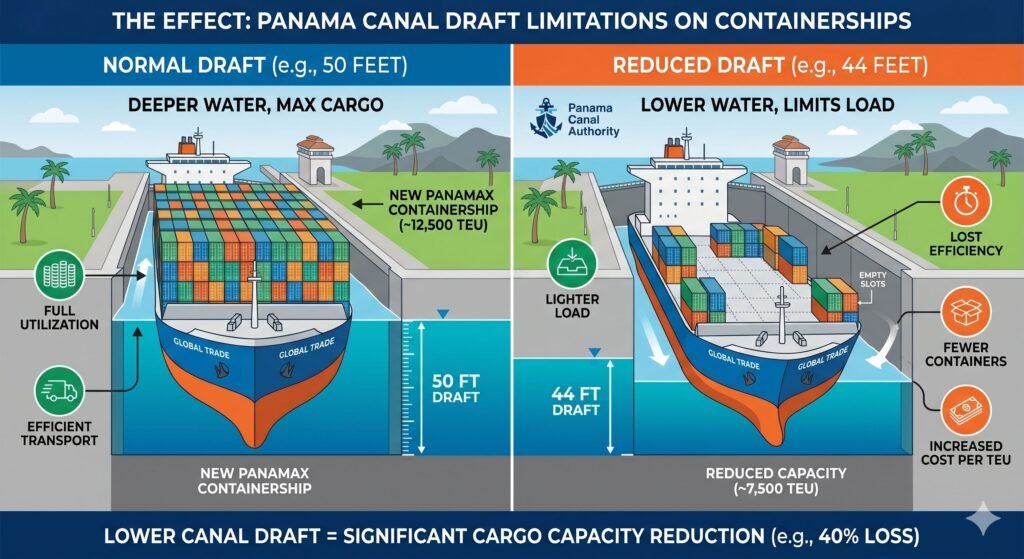
Ultimately, these shifts increase demurrage and insurance risks, forcing the industry to integrate canal capacity planning directly into voyage economics to mitigate financial exposure.
Future Outlook: Long-Term Panama Canal Water Management
The immediate next steps for the ACP involve monitoring Gatun Lake levels daily and adjusting transit capacity as needed to prevent a total standstill. However, the maritime industry faces a period of sustained commercial risk. If the El Nino cycle persists or intensifies, the maximum authorized draft could fall as low as 44 feet, as seen during the severe 2023 drought. Such a drastic reduction would effectively bar the largest container ships from the waterway, forcing a massive reorganization of Transpacific trade routes.
Looking ahead, the ACP is investigating long-term engineering solutions, such as new water-saving basins and the identification of alternative freshwater sources, to decouple canal operations from volatile rainfall patterns. For now, however, the industry remains at the mercy of the weather, with the July 1 deadline serving as a stark reminder that climate resilience is now a core requirement for global logistics planning.
El Nino effect
The upcoming draft restrictions represent more than just a minor technical adjustment; they are a signal of the “new normal” for the Panama Canal. By taking preemptive action, the ACP aims to maintain a stable, albeit reduced, flow of traffic through the summer months. For the shipping world, the focus must remain on precision planning and flexibility to navigate the dual challenges of climatic volatility and the economic pressures of a constrained primary trade route.
Data & Sources
– Panama Canal Authority (ACP)
– World Meteorological Organization (WMO)
– Kuehne+Nagel Industry Analytics