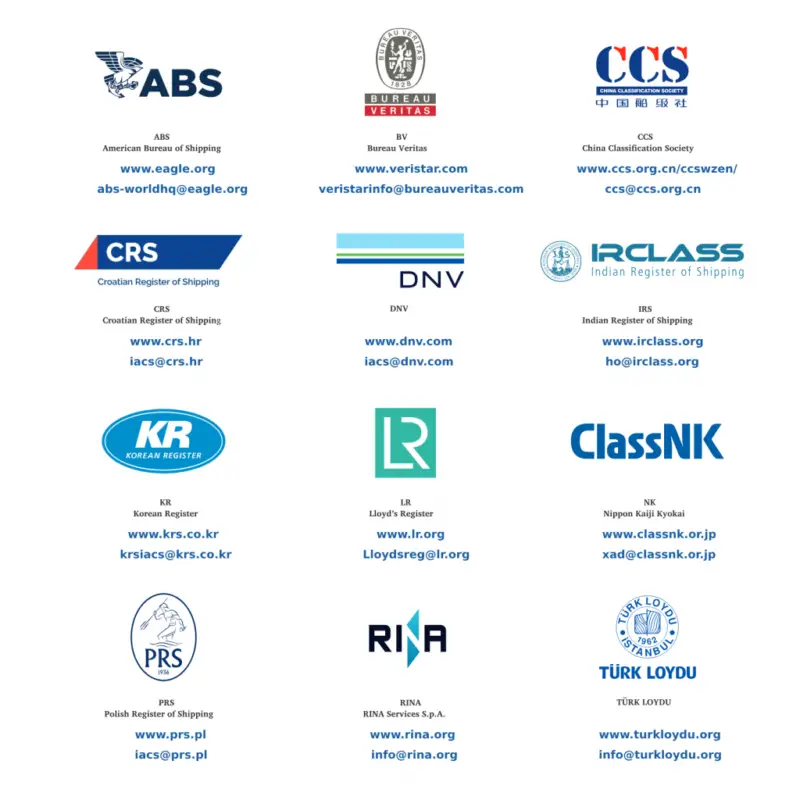
Classification societies play a pivotal role in shaping the maritime industry by setting technical standards, ensuring vessel safety, and guiding innovation. Recent announcements from leading organizations such as IACS, DNV, Lloyd’s Register (LR), ABS, and Bureau Veritas highlight major advancements in sustainability, cybersecurity, and vessel design.
1. IACS Strengthens Industry Framework
The International Association of Classification Societies (IACS) has updated its position papers to address critical challenges:
- Container Ship Safety: Enhanced guidelines to prevent fires and container losses.
- Cyber Resilience: Reinforced compliance with UR E26/E27 for onboard systems.
- Digitalization & MASS: Support for autonomous ship integration and risk assessments.
- Decarbonization: Technical guidance for ammonia, methanol, hydrogen, and carbon capture systems.
- Nuclear Propulsion: Recognized as a potential zero-emission solution for future fleets.
2. DNV Explores Nuclear Propulsion
DNV published a white paper on nuclear propulsion, emphasizing:
- Near-zero emissions potential for ocean-going vessels.
- Modular reactor designs as a cost-effective solution.
- Regulatory and safety challenges that need global collaboration.
3. Lloyd’s Register Introduces New Container Ship Rules
LR announced:
- Compliance with UR C6 & C7 for container securing systems.
- Roll Design Assessment (RDA) notation to predict and mitigate excessive rolling, reducing container loss risks.
- Effective for newbuild contracts from July 2025.
4. DNV Class Rule Updates
DNV introduced:
- In-operation class framework clarifying responsibilities between shipyards and operators.
- New notations for gas-fueled hydrogen systems, onboard carbon capture, and boil-off gas systems.
- Additional rules for live fish carriers and stability pontoons.
5. ABS Highlights Cybersecurity Risks
ABS Consulting warns that ransomware remains the top maritime cyber threat. Recommendations include:
- Compliance with IACS UR E26/E27 and IEC 62443 standards.
- Multi-factor authentication and OT network segmentation.
6. Yacht Safety & Environmental Consortium
Lloyd’s Register, DNV, ABS, Bureau Veritas, and RINA formed the Yacht Safety & Environmental Consortium (YSEC) to:
- Improve safety and sustainability standards for yachts over 24 meters.
- Develop unified guidelines for tonnage calculations and environmental indices.
7. Industry-Wide Push for Decarbonization
Classification societies are collaborating with IMO to accelerate adoption of alternative fuels and digital solutions, ensuring compliance with global emissions targets.
Conclusion
These developments reflect a strong industry commitment to safety, sustainability, and digital transformation. From nuclear propulsion research to cybersecurity frameworks, classification societies are shaping the future of maritime operations.
References
- International Association of Classification Societies (IACS) – Position Papers on Safety, Cybersecurity, and Decarbonization.
- DNV – White Paper on Nuclear Propulsion and Class Rule Updates.
- Lloyd’s Register – Container Ship Safety Rules and RDA Notation.
- ABS Consulting – Cybersecurity Risk Reports.
- Yacht Safety & Environmental Consortium (YSEC) – Industry Collaboration Announcement.
