39
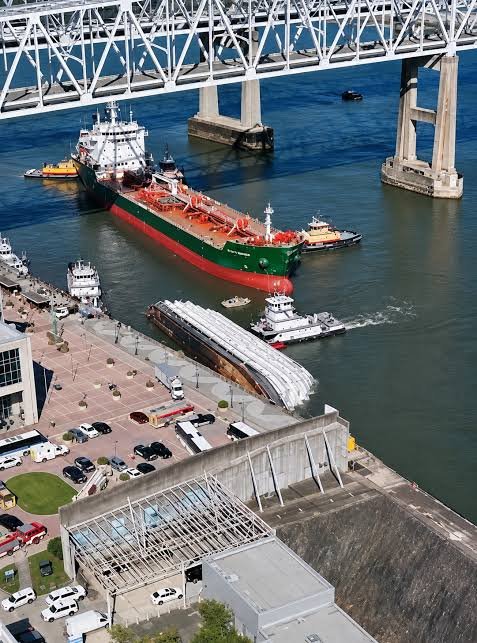
Mississippi River Collision: Chemical Tanker Strikes and Capsizes Docked Cruise Vessel in New Orleans
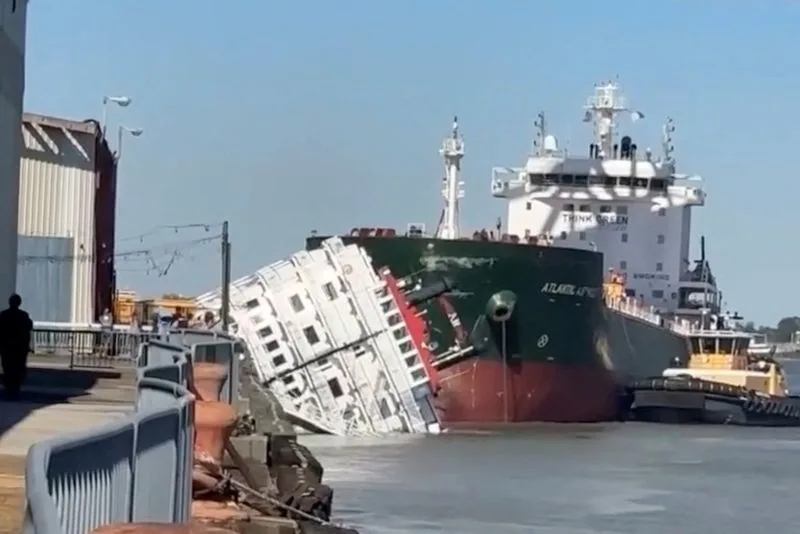
A major marine casualty unfolded on Friday, November 13, 2026, when the Marshall Islands-flagged chemical tanker Atlantic Asphalt collided with the docked paddlewheel cruise ship American Heritage on the Mississippi River at the Port of New Orleans.
Vessel Particulars
- Atlantic Asphalt (IMO: 9798428): A 17,764-dwt specialized product and asphalt carrier built in 2017, operating under local pilotage at the time of the incident.
- American Heritage: Operated by American Cruise Lines, the 279-foot U.S.-flagged paddlewheeler accommodates up to 150 passengers and features a shallow-draft river hull configuration.
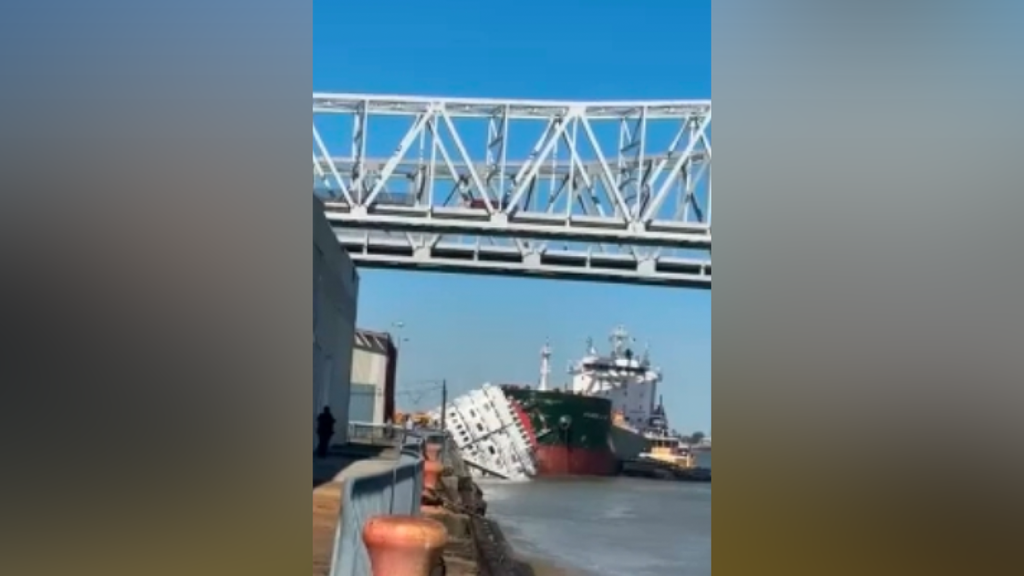
The violent impact breached the passenger vessel’s hull, triggering rapid flooding that caused the 11-year-old riverboat to list heavily and roll completely onto its side within 15 minutes. Miraculously, despite the dramatic capsize alongside the pier, authorities confirmed that all passengers and crew were accounted for, averting what could have been a catastrophic loss of life.
Courtesy Fox news
Incident Timeline and Rescue Operations
The collision occurred at approximately 12:30 p.m. local time near 1350 Port of New Orleans Place. The Atlantic Asphalt—a 520-foot (160-meter) asphalt and bitumen carrier—struck the port side of the stationary riverboat, which was safely berthed after completing an itinerary with roughly 129 passengers plus crew onboard.
Witnesses and captured video footage showed passengers scrambling to balcony railings and donning life jackets as the ship rapidly took on water. Several individuals entered the 66°F (19°C) river before a rapid multi-agency response team pulled them to safety.
- Evacuation & Medical Response: Port police, local fire departments, emergency medical services, and U.S. Coast Guard units swarmed the area. A triage center was established inside the Port of New Orleans administration building.
- Casualties: While zero fatalities were reported, at least 32 people sustained injuries requiring transport to local hospitals.
- Official Reaction: Local and state leaders, including New Orleans Mayor Helena Moreno and Louisiana Governor Jeff Landry, praised the swift emergency response, dubbing the outcome the “miracle on the Mississippi.”
Navigational Fallout and Immediate Priorities
Following the collision, the U.S. Coast Guard established an emergency safety zone, closing a three-mile stretch of the Mississippi River between mile markers 93 and 96 to all vessel traffic.
With all personnel accounted for, operational focus immediately shifted toward environmental assessments, wreck stabilization, and clearing the channel. Investigators from maritime authorities are examining helm commands, approach speeds, steering mechanics, and propulsion data on the Atlantic Asphalt to determine the casualty’s root cause. Salvage engineers face a complex operation to right and remove the heavily damaged riverboat from the active commercial fairway.
Navigating the Corridor: Pilotage Protocols and Risk Management on the Lower Mississippi River
The high-profile collision turns a sharp spotlight on the intricate mechanics governing traffic flow, pilotage, and risk mitigation along the Lower Mississippi River (LMR). Moving thousands of commercial hulls annually through swift currents and constrained urban waterfronts requires rigid operational discipline.
Compulsory Pilotage and Local Expertise
Navigating the LMR demands deep local knowledge due to shifting silting patterns, strong seasonal currents, and dense commercial congestion.
- State and Federal Pilots: Under Louisiana law and federal statutes, foreign-flagged commercial tonnage and registered vessels over 250 net tons must utilize licensed pilots. State-commissioned river pilots take the helm from the Bar Pilots at the passes up to New Orleans, guiding deep-draft assets through complex urban bends.
- Maneuvering Constraints: Large tankers operating under pilotage share the fairway with nimble tug-and-barge push-tows and stationary passenger vessels. Maintaining safe stopping distances against river currents exceeding several knots leaves little margin for error.
Vessel Traffic Services (VTS) and Mandatory Monitoring
The U.S. Coast Guard Sector New Orleans operates Vessel Traffic Service Lower Mississippi River (VTS LMR) to oversee safety from Port Hudson down to the Southwest Pass.
- Vessel Movement Reporting System (VMRS): Commercial traffic, self-propelled vessels over 40 meters, and passenger ships carrying 50 or more fare-paying guests must maintain active Automatic Identification System (AIS) transponders and continuous bridge-to-bridge radio watches on designated VHF channels.
- Traffic Controls: VTS authorities enforce specific transit windows, speed restrictions near infrastructure or moored assets, and special area rules (such as Wilkinson Point) to prevent suction, wake damage, or collision events in tight bends.
Managing Risk in High-Density Fairways
Incidents like the New Orleans casualty trigger immediate operational reviews concerning urban interface safety. Key mitigation layers include:
- Power Availability: Emerging protocols require strict verification that main propulsion machinery and shaft power limiters can be overridden instantly upon pilot request during emergency maneuvering.
- Berth Separation and Proximity: Regulators continually weigh the risks of active deep-draft traffic transiting immediately adjacent to high-capacity passenger vessel berths within confined port zones.
Raising the Deadweight: Marine Salvage and Wreck Removal Engineering for Capsized Passenger Vessels
When a passenger vessel capsizes right alongside a busy urban pier, salvage masters face a brutal engineering puzzle. Unlike open-ocean casualties where a hulk can sometimes be scuttled or left to the elements, an inland waterway wreck in a critical commercial fairway demands immediate, surgical removal.
Salvage engineering in confined river channels requires balancing stability physics, structural integrity, and strict environmental containment.
The Salvage Sequence: Stabilization and Pollutant Removal
Before a heavy-lift crane can even touch a capsized hull, naval architects and salvage master teams must stabilize the site.
- Environmental Mitigation: Securing fuel tanks and removing lube oils, oily bilge water, and hazardous stores takes absolute priority. Heavy-lift and pollution-response barges deploy containment boom arrays around the perimeter to trap any leaking bunker fuel before salvage cutting begins.
- Hull Integrity and Stress Analysis: Rolling a multi-deck vessel back upright or lifting it in sections creates massive, unpredictable bending moments. Naval architects run finite element analysis (FEA) models on the submerged structure to identify where the hull frame will buckle under its own flooded weight.
Righting vs. Sectional Removal
Choosing the extraction method depends entirely on the vessel’s residual strength and river depth constraints.
- Parbuckling (Righting): If the hull structure remains largely intact, salvors rig heavy purchase wires beneath the keel, connecting them to shore-side winches or specialized sheerleg floating cranes. Controlled ballasting and counter-flooding help roll the vessel back to an even keel.
- Piece-Small Extraction: If internal bulkheads are heavily compromised or the channel width is too narrow for a full rotation, divers and cutting crews dismantle the superstructure piece by piece underwater. Heavy cranes then lift the segments out segment by segment onto deck barges.
Navigational Reopening and Channel Clearance
The ultimate metric of a successful inland salvage operation is the restoration of vessel traffic. U.S. Coast Guard Captains of the Port (COTP) will not reopen a restricted fairway until hydrographic multibeam sonar surveys confirm zero bottom-shoaling or debris obstruction remains in the dredged channel. For marine operations teams, speed is measured not just in tons lifted, but in hours shaved off commercial downtime.
