
Hengli Heavy Industries: The Industrial Blitz Reshaping Global Orderbooks
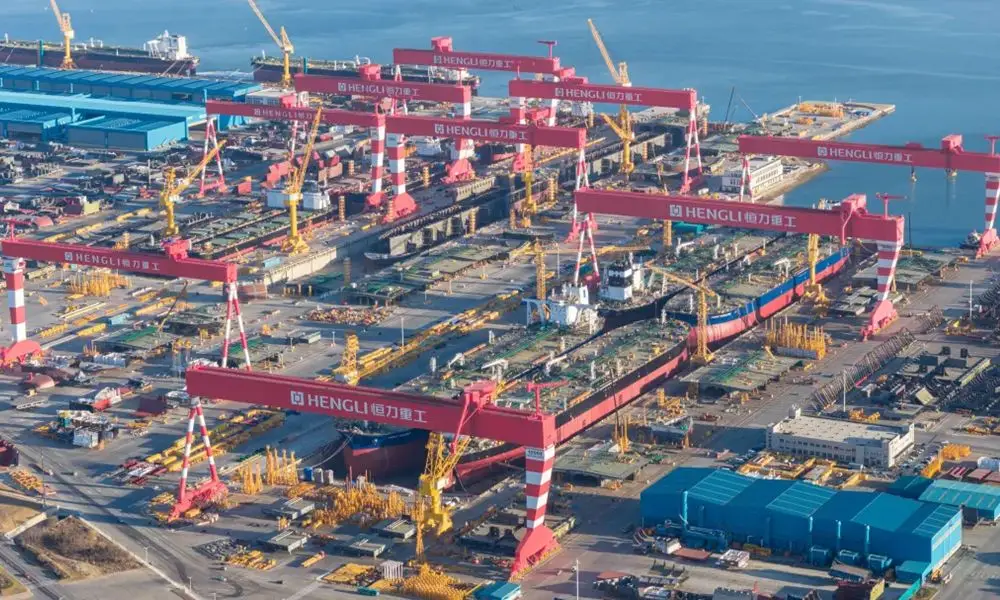
In the four years since Hengli Heavy Industries acquired the shuttered STX Dalian facility, the shipyard has transformed from a distressed asset into the most aggressive player in the global maritime market. With a backlog exceeding 330 vessels—representing over 12 million compensated gross tonnes (CGT)—the yard has established itself as the largest private shipbuilder in China by volume. By 2028, Hengli aims to hand over at least 160 ships in a single year, a delivery cadence that ranks among the most rapid industrial accelerations in maritime history.
The Infrastructure of Scale: A “Future Factory”
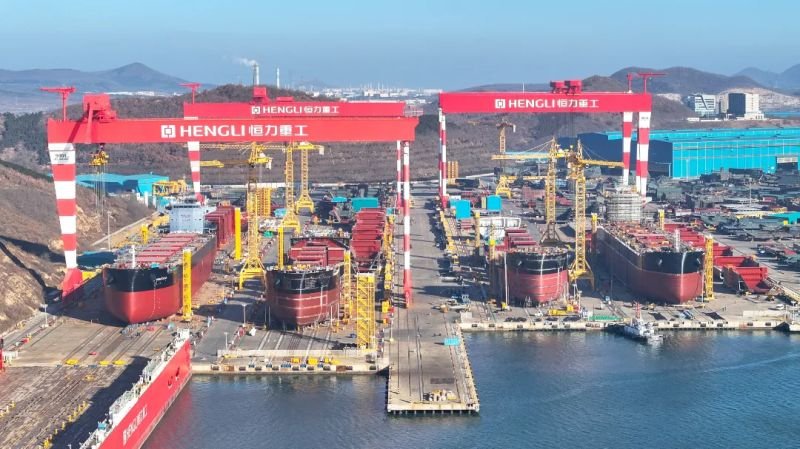
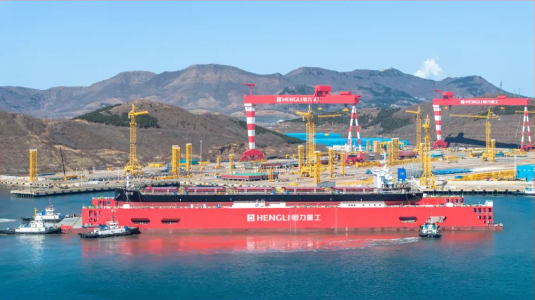
Located in the Changxing Island Economic and Technological Development Zone (EDZ) in Dalian, Liaoning, China, the facility is designed as a single-unit shipbuilding powerhouse. Its “Future Factory” expansion, which reached full operation in early 2025, covers over 2 million square meters of building space, including 17 high-tech workshops.
The facility’s scale is characterized by infrastructure designed for high-volume, high-precision output:
-
Dry Docks: The shipyard operates expansive dry docks, including units reaching 860 meters in length. These docks have already made history, with the simultaneous launch of four 306,000 DWT Very Large Crude Carriers (VLCCs)—an industry-first operation.
-
Throughput & Capacity: The site is designed for an annual steel processing capacity of approximately 2.3 million tons and is aggressively building toward an output of 180 marine engines annually.
-
Expansion Investment: A 13.5 billion yuan ($1.9 billion) investment plan is currently under execution. This project will upgrade berths 3–6 and construct outfitting quays capable of supporting 22 vessels simultaneously under construction—10 under 200,000 DWT and 12 above that threshold.
Strategic Pivot: From Bulk to “Future-Ready” Tonnage
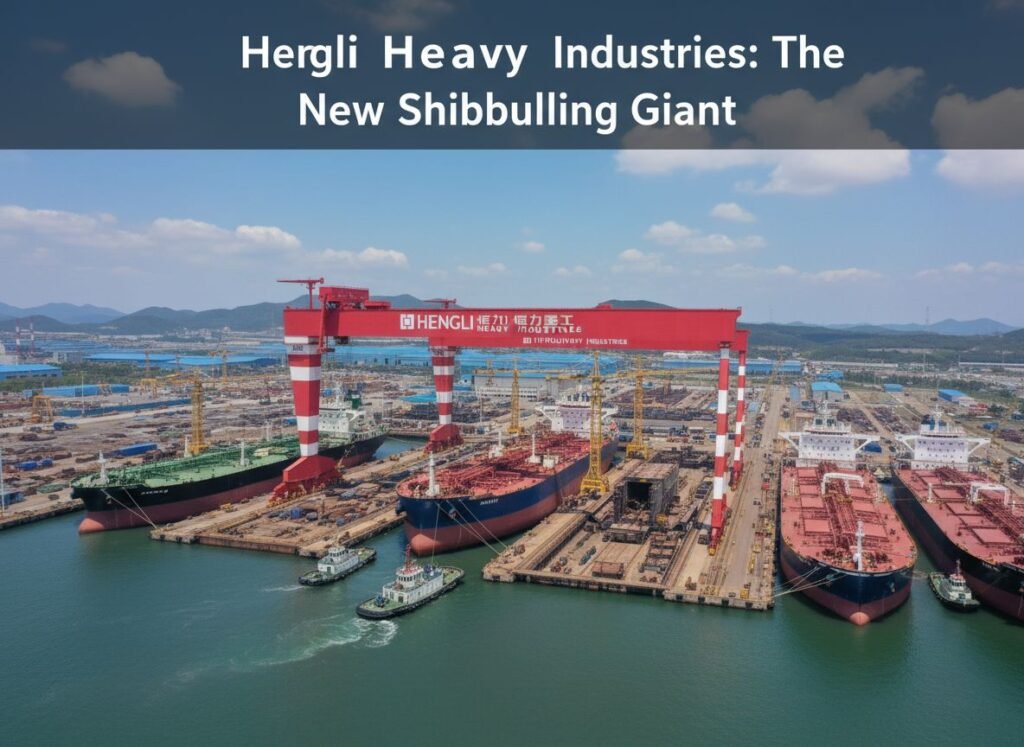
Hengli’s emergence was initially built on the “bread and butter” of bulk shipping: Kamsarmax and Capesize carriers. However, the yard has aggressively pivoted its technical capabilities. As South Korean and Japanese shipyards report delivery slots fully booked into 2029, global shipowners—including major Greek and European lines—are shifting to Hengli to secure earlier delivery windows.
The current production mix is a sophisticated portfolio of high-value assets:
-
Tankers: Suezmax crude carriers, LR2 product tankers, and VLCCs account for roughly 50% of the yard’s contracted CGT.
-
Containerships: Market breakthroughs in 2026 include orders for 6,000 TEU and ultra-large vessels exceeding 20,000 TEU.
-
Vertical Integration: Hengli is insulating itself from global supply chain volatility by developing a dedicated “Ship Power System Industrial Park.” By manufacturing its own internal engines and propulsion systems, the yard significantly reduces reliance on third-party suppliers, a major strategic advantage in a supply-constrained market.
The Human Logistics of a “Company Town”
The goal of employing 50,000 people creates a logistical challenge that most legacy shipyards would find insurmountable. However, Hengli operates within the Dalian Changxing Island EDZ, a state-level administrative district designed as a self-sufficient industrial satellite city.
-
Integrated Residential Planning: The EDZ features dedicated residential and commercial districts built in tandem with the shipyard. These are modern, permanent complexes designed to house engineers, technicians, and their families, supported by comprehensive public services, including schools and hospitals.
-
The 15-Minute Hub: By concentrating housing, logistics, and production within a single, highly controlled zone, the yard minimizes the commute-related friction common in fragmented urban shipyards. This “company town” model is a key pillar in the yard’s strategy for retaining the specialized labor necessary for advanced green shipbuilding.
-
Connectivity: While the island provides a contained environment, it is fully integrated into the broader Dalian municipal network. Extensive bridge and highway links ensure the yard remains connected to the city, facilitating accessibility for senior management and the high-level technical talent migrating from other industrial centers.
Challenges of the Industrial Blitz
Despite the impressive infrastructure, the sheer velocity of this expansion introduces significant operational and geopolitical friction.
1. The Quality Assurance Challenge
Scaling from 17 deliveries in 2025 to 160 by 2028 is a “safety gap” that maritime insurers and technical managers are watching closely. The challenge lies in maintaining strict quality assurance across a rapidly expanding, less-experienced labor pool. As the shipyard moves from bulk carrier production to complex, alternative-fuel-ready tonnage, the demand for precision technical supervision increases exponentially.
2. Geopolitical and Trade Headwinds
The shipyard operates under the shadow of global trade scrutiny. Geopolitical tensions, including potential U.S. port fees on Chinese-built vessels and investigations into “unfair” state-linked subsidies, create long-term uncertainty for international shipowners. The “Military-Civil Fusion” strategy associated with large-scale Chinese infrastructure adds a layer of regulatory caution, potentially complicating future international partnerships or financing options for specific export markets.
3. Supply Chain and Technical Obsolescence
While Hengli is vertically integrating, it remains reliant on complex global sub-suppliers for digital sensors and advanced fuel systems. Furthermore, as the IMO’s decarbonization roadmap accelerates, the yard must maintain the agility to retool its “Future Factory” configurations. The current reliance on strong local government support—which accounts for a significant portion of the region’s GDP—makes the shipyard’s financial stability sensitive to changes in national industrial policy.
The Bottom Line
For the international maritime community, Hengli represents a critical lifeline for fleet renewal. As aging assets face increasingly punitive carbon taxes and stringent IMO mandates, the yard’s ability to deliver “eco-design” vessels on a predictable timeline has become its most valuable commodity.
However, as the 2028 horizon approaches, the industry remains in a “wait-and-see” mode. Hengli’s performance over the next 24 months will dictate whether this expansion is a successful new benchmark for industrial scaling or a high-risk gamble. For now, the “Industrial Blitz” continues, with every launch from the Changxing Island dry docks serving as a stress test for the company’s ability to balance the demands of volume, quality, and long-term sustainability in an increasingly volatile global market.